Few things in product management are as fundamental-and as frequently misunderstood-as the value proposition. Every company claims to offer value. But what does that really mean? And how do you ensure your product actually delivers on that promise?
In my previous post on Why Defining Your Ideal Customer Profile (ICP) Is the Cornerstone of Product Management Alignment, I explored how a well-defined ICP anchors an organization around its most important customers. The ICP tells you who you (should) serve. But there’s an equally critical question: how do you serve them? That’s where the value proposition comes in-and more specifically, where the Value Proposition Canvas becomes indispensable.
What Is a Value Proposition?
At its core, a value proposition is a clear statement of the tangible results a customer gets from using your product or service. It’s the promise of value to be delivered. But unlike a tagline or marketing slogan, a strong value proposition is deeply rooted in customer understanding.
A compelling value proposition answers three fundamental questions:
- What job does the customer need to get done?
- What pains are they experiencing while trying to accomplish that job?
- What gains do they hope to achieve?
When your product addresses these elements effectively-relieving pains, creating gains, and enabling the job to be done-you have what econmoics calls Product-Market Fit. Without this fit, even the best-engineered products fail.
The Value Proposition Canvas: A Visual Tool for Strategic Clarity
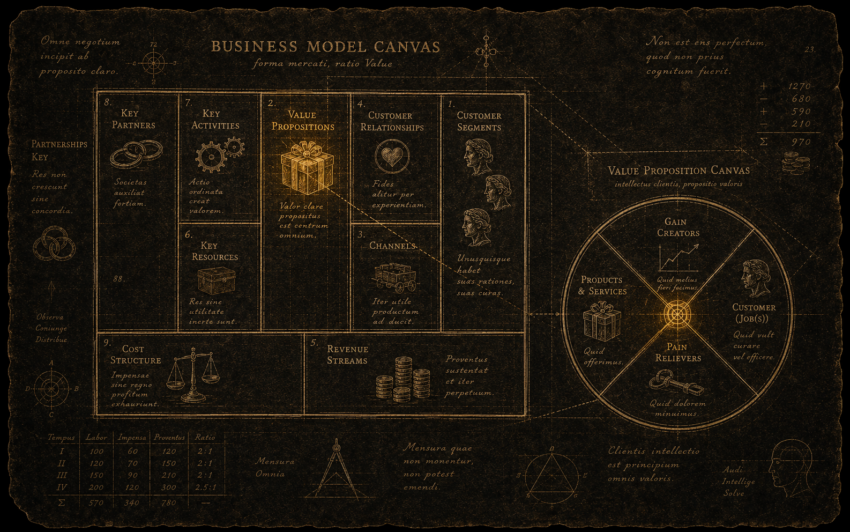
The Value Proposition Canvas was developed by Dr. Alexander Osterwalder and Dr. Yves Pigneur, the minds behind the Business Model Canvas. It’s a practical framework that helps teams design, test, and iterate on value propositions that customers actually want.
The canvas consists of two interconnected parts:
1. The Customer Profile (Right Side)
This side forces you to think deeply about your customer. It’s structured around three elements:
Customer Jobs: What tasks are your customers trying to accomplish? These can be functional (getting a report done), social (looking competent in front of peers), or emotional (feeling secure about a decision).
Pains: What frustrations, obstacles, or risks does the customer face when trying to accomplish their jobs? These are the frictions, the annoyances, the things that keep them up at night.
Gains: What outcomes and benefits does the customer hope for? These can be expected, desired, or even unexpected delights that would make their life easier or better.
2. The Value Map (Left Side)
This side describes how your product creates value:
Products and Services: What are you offering? This is the list of products, services, and features that help the customer get their job done.
Pain Relievers: How does your offering specifically alleviate customer pains? Be concrete-vague claims don’t count.
Gain Creators: How does your offering generate customer gains? Again, specificity matters.
The magic happens when you achieve fit-when your pain relievers and gain creators directly map to significant customer pains and gains. This isn’t about listing features; it’s about demonstrating relevance.
Case Study: Klarna and the Art of Finding Fit
Theory is one thing. But what does a well-designed value proposition actually look like in practice? Let’s look at Klarna-a company that built a multi-billion-dollar business by rethinking a concept most people had dismissed as old-fashioned: paying by invoice.
Background
Klarna was founded in Stockholm in 2005 with a straightforward premise: make online payments simpler, safer, and more flexible for buyers-while eliminating the biggest fear for merchants: payment default. By 2021, the company had reached a valuation of $46 billion, making it one of Europe’s most valuable fintech companies. Its core product, Buy Now Pay Later (BNPL), a model in core an identical twin to buy upon invoice – a very popukar method especially in Germany andseveral oter European countries. Klarna’s successful business model has since been copied by PayPal, Apple Pay, Affirm, and Afterpay. That’s usually a reliable signal that someone got the value proposition right.
The Customer Profile: Understanding Two Distinct Segments
Klarna operates a two-sided market, which means it needs two distinct value propositions-one for consumers and one for merchants.
B2C – The Online Shopper
Customer Jobs:
- Complete an online purchase quickly and confidently
- Manage cash flow without disrupting daily finances
- Buy goods and inspect them before committing payment
- Return items without the hassle of waiting for a refund
Pains:
- Having to pay upfront before knowing if goods arrive or match the description
- Complex checkout flows with logins, redirects, and 2FA friction (the classic PayPal problem)
- Fear of fraud or non-delivery with no recourse
- Tying up money in purchases that might be returned
Gains:
- Flexibility to pay later or in installments without interest (in the standard model)
- A single, clean overview of all outstanding payments
- The security of disputing orders without having already paid
- Faster, simpler checkout-sometimes just two or three clicks
B2B – The Online Merchant
Customer Jobs:
- Maximize conversion at checkout
- Offer flexible payment options without taking on financial risk
- Reduce cart abandonment caused by payment hesitation
Pains:
- The default risk of traditional invoice-based payment-merchants who offer “pay upon invoice” carry the risk themselves
- Friction in the checkout experience that causes customers to abandon carts
- Delays in cash flow when payment arrives days or weeks after dispatch
Gains:
- Immediate payout from Klarna (Klarna absorbs the default risk)
- Higher conversion rates because buyers don’t have to commit money upfront
- Access to Klarna’s existing user base through platform integration
The Value Map: How Klarna Responds
For Consumers
Pain Relievers:
- No upfront payment required-buyers pay after receiving and inspecting goods
- Magic links and in-checkout TAN verification replace cumbersome redirects; security without the friction
- Dispute functionality provides a safety net against fraud or damaged goods
- Automatic reminders and a payment overview reduce the cognitive load of managing multiple purchases
Gain Creators:
- Free 30-day payment deferral as the default option
- Zero-interest installment plans for splitting larger purchases
- A unified shopping and payments platform that consolidates purchase history, tracking, and returns
- The Klarna Card extends BNPL to offline purchases and platforms that don’t natively support Klarna
For Merchants
Pain Relievers:
- Klarna assumes the default risk entirely-merchants receive payment regardless of whether the buyer pays on time
- Checkout integration reduces drop-off at the payment step
- White-label options and PSP partnerships (Payone, Mollie) allow seamless embedding
Gain Creators:
- Documented increases in conversion rates and average order values
- Access to data on buyer behavior through the Klarna Checkout API (launched 2019)
- A built-in customer base that trusts and actively searches for Klarna at checkout
Where Fit Is Achieved-And Where It Gets Complicated
The core fit is clear: Klarna addresses the most significant friction points in online shopping for both sides of the market simultaneously. The consumer doesn’t pay upfront; the merchant doesn’t carry risk. That’s a genuine value exchange, not just a feature list.
But here’s what makes Klarna an instructive case rather than just a success story: the efficiency that creates value for customers can also work against them.
Klarna’s model is optimized for transaction efficiency-speed, convenience, minimal cognitive load at checkout. And it delivers on this brilliantly. The problem is what happens downstream. The same frictionless experience that makes buying easy also makes overspending easy. According to a 2022 study cited by The Guardian, 41% of BNPL borrowers in the UK had missed a payment-up from 11% the year before. Younger consumers and those already struggling to access conventional credit were disproportionately affected.
This is not just a social responsibility issue-it’s a product design challenge. A framework called the efficiency/effectiveness matrix (borrowed from fintech research) is useful here: Klarna scores extremely high on efficiency (transaction cost, simplicity, speed), but the effectiveness dimension-the quality of financial decisions it enables-is more ambiguous. As one fintech scholar put it: “FinTech has solved transaction efficiency but needs to solve decision quality.”
Klarna has begun addressing this. The platform now sends payment reminders, shows upcoming charges, and offers integrated banking that could theoretically surface spending patterns. The Klarna banking integration already captures enough data to build a smart financial advisor layer-one that could warn users when a purchase would exceed their monthly budget or flag patterns of overextension. The business model tension is obvious: recommending against a purchase means less revenue. But for a company building long-term trust with consumers, this kind of proactive guardrail could become a genuine differentiator-especially as regulators in the UK and EU begin to tighten the rules around BNPL.
The Lesson for Product Managers
Klarna demonstrates both the power and the responsibility embedded in a well-executed value proposition. When you genuinely address the jobs, pains, and gains that matter to your customers, adoption follows. But “fit” is not a static achievement-it’s an ongoing design challenge. The same features that create value in one dimension can create harm in another.
The Value Proposition Canvas helps you find fit. It doesn’t automatically tell you whether that fit is sustainable, ethical, or complete. That’s the judgment call that separates good product management from merely clever product design.
The Business Model Canvas: The Higher Flight Level
To understand where the Value Proposition Canvas sits, it helps to zoom out first. Think of the two tools as operating on different flight levels-the Business Model Canvas gives you the aerial view of the entire business, while the Value Proposition Canvas zooms in on the terrain that matters most.
The Business Model Canvas, also created by Osterwalder and Pigneur, is a strategic management tool that captures how an entire business creates, delivers, and captures value-all on a single page. It consists of nine building blocks:
- Customer Segments – Who are you creating value for?
- Value Propositions – What value do you deliver?
- Channels – How do you reach customers?
- Customer Relationships – How do you interact with customers?
- Revenue Streams – How do you capture value?
- Key Resources – What assets do you need?
- Key Activities – What must you do well?
- Key Partnerships – Who helps you deliver?
- Cost Structure – What are your major costs?
The Value Proposition Canvas is not a separate tool-it’s a deliberate deep-dive into two of these nine blocks: Customer Segments and Value Propositions. Where the Business Model Canvas answers “how does the business work?”, the Value Proposition Canvas answers the more fundamental question underneath it: “why would a customer actually care?”
This hierarchy matters in practice. A common mistake in product and strategy work is jumping straight to the detailed value proposition without first establishing the broader business model context-or conversely, filling in a Business Model Canvas with a value proposition block that is vague and unvalidated. The right sequence is: start with the Business Model Canvas to establish the overall logic of the business, then use the Value Proposition Canvas to pressure-test the most critical assumption at its core.
In Klarna’s case, the Business Model Canvas reveals how the value proposition is only one piece of a carefully constructed system: AWS as cloud infrastructure (Key Resource), retail exclusivity agreements with H&M, Zara, and Conrad (Key Partnerships), interest and installment fees as revenue streams alongside merchant commissions (Revenue Streams), and the platform itself as the central channel for both consumer and merchant relationships.
Strip away the value proposition-the frictionless BNPL experience that solves real pains for both buyers and merchants-and the rest of the business model has nothing to stand on. That’s the point: you can design the most elegant business model, but if your value proposition doesn’t resonate with your target customers, the model collapses under its own weight. The Business Model Canvas shows you the architecture; the Value Proposition Canvas tells you whether the foundation is solid.
Why These Tools Matter for Product Managers
For product managers, the Value Proposition Canvas and Business Model Canvas are more than theoretical frameworks-they’re decision-making tools. They help answer questions like:
- Should we build this feature? (Does it relieve a significant pain or create a meaningful gain?)
- Are we solving a real problem? (Have we validated customer jobs and pains?)
- Is this a viable business? (Does the value proposition support a sustainable business model?)
These canvases also create alignment across teams. When marketing, sales, product, and engineering share a common visual language for discussing customers and value, meetings become more productive and strategies become more coherent.
In my experience, the best product teams don’t just create these canvases once-they iterate on them continuously as they learn from customers. The canvas is a living artifact, not a one-time exercise.
A Core Part of MBA Education
If you’re pursuing formal business education, you’ve likely already encountered these frameworks. The Business Model Canvas and Value Proposition Canvas have become standard teaching tools in MBA programs around the world. Universities including Stanford, MIT, Harvard, and countless others incorporate these canvases into their entrepreneurship, strategy, and innovation curricula.
During my own MBA journey at Goethe Business School Frankfurt, these visual frameworks were integral to how we analyzed cases, developed business plans, and pressure-tested startup ideas-including a deep analysis of Klarna’s model as part of a Digitalization in Finance module. The canvases provide a common vocabulary that transcends industries and company sizes-whether you’re a solo founder or a strategy consultant at a Fortune 500 company.
The adoption of these tools in formal education underscores a broader shift: business strategy is no longer just about spreadsheets and slides. Visual thinking, rapid prototyping, and customer-centric design have become essential skills for modern business leaders.
Getting Started: Resources and Deep Dives
If you’re ready to put these frameworks into practice, here are my recommendations:
Free Downloads from Strategyzer
Strategyzer, the company co-founded by Osterwalder, offers free downloadable templates directly on their website-no purchase required:
- Value Proposition Canvas Template (PDF)
- Business Model Canvas Template (PDF)
- 30+ additional tools, guides, and assessments in Strategyzer’s Resource Library
Essential Books
- Business Model Generation by Alexander Osterwalder and Yves Pigneur (Wiley, 2010) – the book that started it all
- Value Proposition Design by Osterwalder, Pigneur, Bernarda, and Smith (Wiley, 2014) – the essential deep-dive into the canvas
- Testing Business Ideas by David J. Bland and Alexander Osterwalder (Wiley, 2019) – 44 experiments for rapid validation
- The Invincible Company by Osterwalder et al. (Wiley, 2020) – how companies like Amazon and Airbnb continuously reinvent their business models
Connecting ICP, Value Proposition, and Business Model
If you’ve read my post on defining your Ideal Customer Profile, you’ll see how these concepts form a coherent system:
- ICP defines who your ideal customers are
- Value Proposition Canvas articulates what value you create for them and how your product addresses their specific jobs, pains, and gains
- Business Model Canvas shows how you deliver and capture that value as a sustainable business
Together, these frameworks create strategic alignment from customer understanding all the way through to revenue capture. They transform abstract discussions about “customer centricity” into concrete, testable hypotheses.
Closing Thought
In a world where most new products fail to meet expectations-some studies suggest as many as 72% don’t deliver on their promise-the Value Proposition Canvas offers a disciplined way to design products customers actually want.
Klarna’s story is a good reminder of what that looks like in practice. A concept dismissed as outdated (pay upon invoice) became a multi-billion-dollar business because someone took the time to map it properly against real customer jobs, pains, and gains-and then built a system that genuinely delivered. The canvas didn’t create Klarna’s success. But it’s exactly the kind of thinking that made it possible.
The canvas won’t guarantee success. But it will dramatically increase your odds by forcing the hard conversations early: Do we really understand our customers? Does our product actually address their most important pains and gains? Is there genuine fit?
These are the questions that separate good product thinking from wishful thinking. And in product management, that distinction makes all the difference.
For more insights on product leadership, strategy, and the intersection of business and technology, explore Ship & Lead.