
“Isn’t it ironic?” was the striking line of “Ironic”, the international smash hit from Canadian singer Alanis Morissette’s 1995 album Jagged Little Pill. The 90s were the height of the golden era for the music industry. Plenty of genres, new artists who strived to get from the underground or the streets and subways of Western metropolises to stardom. New media like the Compact Disc were the cheap, easily produced and copied vehicle for the armada of MTV mercenaries that conquered teenagers’ boomboxes, parents’ hi-fi systems and Wall Street brokers’ high-end towers alike. Back in 1995, Microsoft launched its second stage of groundbreaking success to become the first global IT titan with Windows 95. The internet was already alive, but only used by some nerdish college students and tech avant-gardists, Apple was fighting to survive, and Google, Meta and other modern-day giants were not even thought of. Isn’t it ironic? It was the colorful and creative music industry that ran every business model the analytic and often cold software industry now treats as an invention, decades earlier. Interestingly enough, it also lived through the disruption software is entering now – long before disruption was recognized as a business phenomenon. So, my fellow executives, if you want to know where value goes once AI makes code cheap, you should go back in time and study the record business, not the SaaS playbook, to find answers to the most urgent questions of today.
SaaS existed in 1934
Music streaming was invented by Spotify. Absolutely wrong – you might want to go back 100 years to find the real pioneers. In 1906, the Telharmonium – an early electrical organ – already sent live music over telephone lines to paying subscribers in New York. In 1934, Muzak started piping music by wire into businesses, billed as a recurring service – the sound that later gave “elevator music” its name. Business customers paid for continuous access, never for ownership. That is subscription software, seventy years before Salesforce.
Radio added the second model: free to the listener, paid for by advertisers. It was freemium without a direct premium tier, and it doubled as the sales funnel for records. You could say the radio was the freemium agent to the record labels’ premium offer in the form of vinyl, cassettes and later CDs. Labels paid to get airplay because a song heard for free sold the album. Sounds familiar? Every SaaS free trial runs on the same logic.
So when we call recurring revenue the gold standard of software, we are not describing something new. We are describing the music industry’s business model, rediscovered. The interesting question is not where these models came from. It is what happened to music when copying became free, and whether the same thing is about to happen to software.
Scaling the unscalable
Before recording, a musician was an individual project worker. Every performance was billed once, in one room, to one audience. Income scaled with hours on stage and nothing else.
The record changed that. Music was produced once and copied endlessly at near-zero marginal cost. The artist stopped being a service and became a product. Interestingly enough, his music – like the code of a developer today – was very often a company’s intellectual property. The label usually owned the master recording and kept most of every sale.
Software made the same jump. Until 1969, software was a free add-on to the hardware IBM sold. When IBM unbundled it and started charging separately, code became a product in its own right, and an industry was born. Both businesses then sold the same thing: a file you make once and copy forever. For a while they even shipped it on the same media, first on cassettes, then on CDs.
Over the following decades, both industries ran through the same three business models:
| Model | Music | Software |
|---|---|---|
| Buy it | Tape, record, CD, download | Perpetual licence |
| Rent access | Muzak, streaming | SaaS |
| Free, paid by advertisers | Radio | Consumer platforms |
And both kept bundling and unbundling. Singles always existed, but the label decided which tracks became one. iTunes let the customer pick any track at the same price, then Spotify rebundled everything into the playlist and one price for everything. Neither move came from the labels. It took outsiders to drive the music industry’s digital transformation. The software suite was unbundled into point solutions and APIs, now rebundled into platforms. The pattern is the same every time: the unit you sell is defined by the medium, until the medium changes. Isn’t it ironic?
The day copying became free
There is a reason why the record industry needed external agents for change. 1995 wasn’t only the year of Alanis Morissette and Microsoft’s rebirth into adulthood. In July 1995, an internal poll at the Fraunhofer Institute in Erlangen, Germany, changed the fate of music forever. The institute had worked for several years on a compression method for digital audio. That summer, the new format got its name: MP3. In 1997, a student uploaded the encoder software to the internet. Then Napster arrived in 1999 and turned the marginal cost of distribution from near zero to exactly zero. The industry’s first answer was lawyers, not business models. Software reacted to piracy the same way.
Streaming eventually restored revenue. In 2025, US recorded music hit a record $11.5 billion, with streaming at 82% of it. But it did not restore the value of the recording for the people who make it. The money moved somewhere else: to the one thing that cannot be copied.
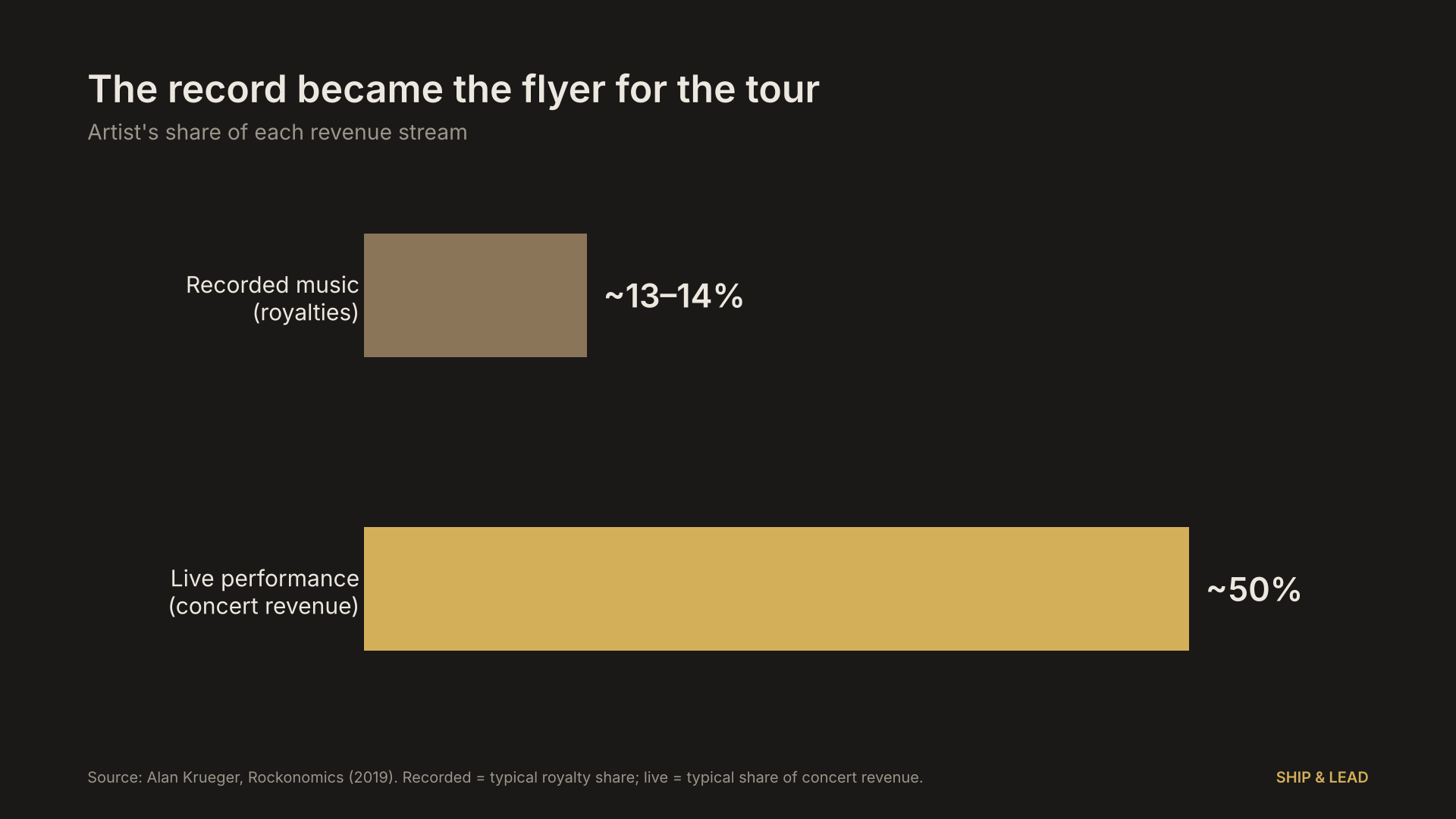
The economist Alan Krueger described the flip precisely. Concerts used to be priced low to sell albums – they had become a marketing value stream like radio and MTV. Now recordings are the loss leader that sells the concert. Artists keep a small slice of recorded royalties but around half of live revenue. In the UK, live music overtook recorded music in revenue as early as 2008.
The lesson for software is simple: when the copyable product loses its value, value moves to what cannot be copied. For music, that was the live performance. The question for every software executive is what the equivalent is in their business.
AI is software’s Napster moment
AI does to code what Napster did to recordings – just faster, relentless and without the joy of being. Producing working software is becoming cheap, fast and available to almost anyone. The copyable asset, the code itself, is losing its scarcity.
In the new context, the rockstar developer becomes a session musician. Session musicians were often better than the stars whose names were on the cover. But they were paid once, rarely credited, and once the sheet music existed, anyone could play the part. AI turns the spec into sheet music. The value moves to whoever writes the score and whoever owns the name on the cover.
The first casualty is the pricing unit. Per-seat pricing is the album of SaaS: a bundle that only existed because the medium required it. Seats made sense when every unit of work needed a human logged in. AI agents do not occupy seats. Worse, under seat pricing, the better your agent works, the fewer seats your customer needs. You are paid to under-deliver.
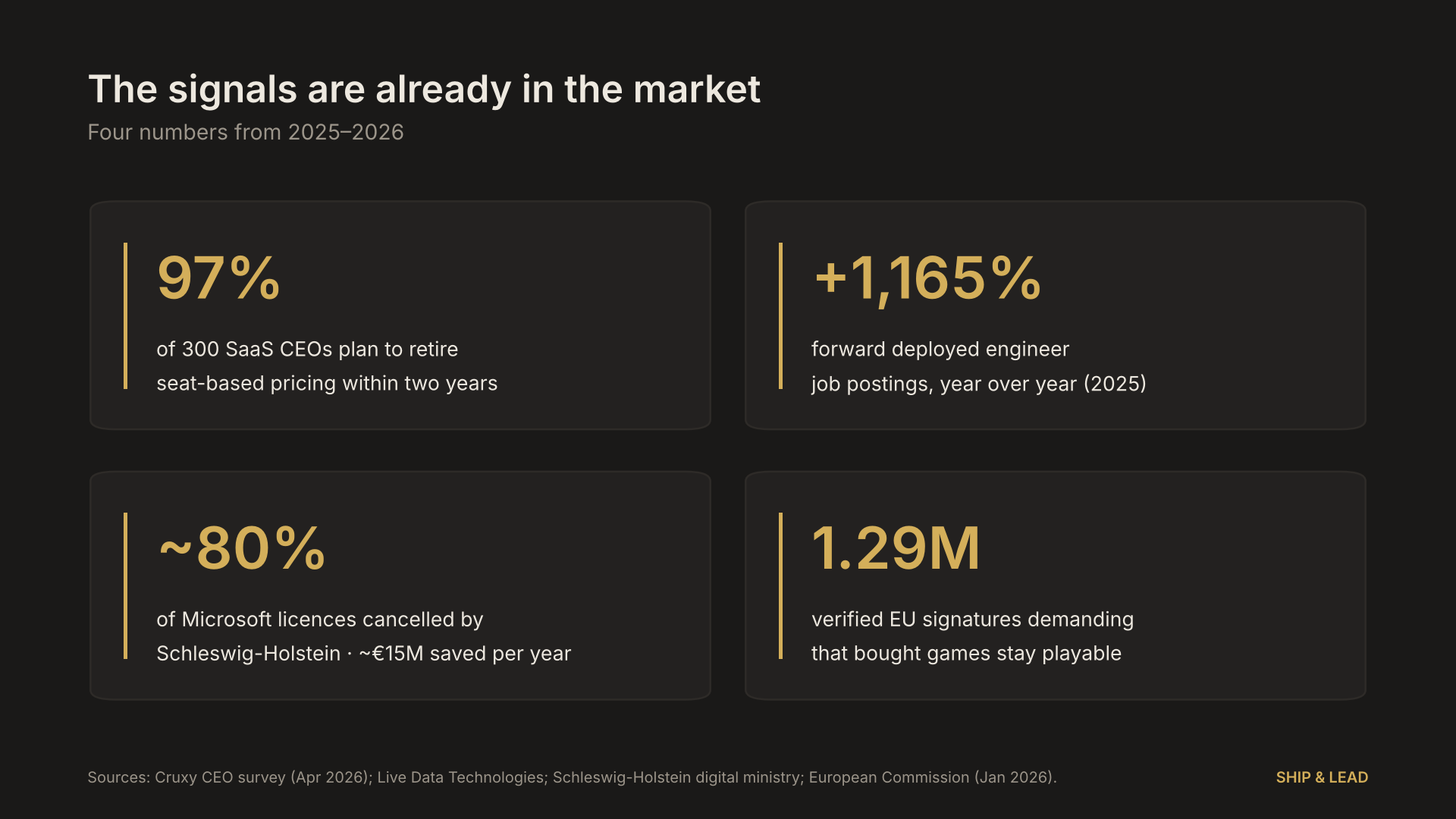
This of course also has implications for executive boards. The market has noticed. In an April 2026 survey of 300 SaaS CEOs, 97% said they plan to retire seat-based pricing within two years, while 94% said it still fits their product’s value today. Gartner expects at least 40% of enterprise SaaS spend to move to usage, agent or outcome-based models by 2030. Pure seat pricing is already becoming rare as a sole metric; most vendors now layer usage or outcomes on top.
The second shift is where the work moves. Software is going on tour. Forward deployed engineers, engineers who embed with customers to make the product actually work in their environment, were one of the fastest-growing roles of 2025, with job postings up 1,165% year over year. Palantir, which invented the role, called it product discovery from the inside. That is the live performance of software: scarce, hard to copy, and paid for by results.
One honest caveat: forward deployment may be a transition, not an end state. Once deploying AI becomes routine, the tour may shrink again. But the direction is clear. Value is moving from the artifact to the outcome.
The buyer’s side of outcome pricing
Outcome pricing sounds fair from the vendor’s seat. From the buyer’s seat, it can look very different. I faced exactly this choice in my past as a CPO and product leader.
Think of a hypothetical use case: a user manual that, over a decade of feature development, became dense with information. But its search describes the complexity of the software instead of reducing it – then you have a real-time issue for your customers. The idea then was to make use of the power of LLMs and integrate a chatbot to replace the product manual for our users. When I had to make the decision, the obvious option was the AI agent of our ticketing system, billed per automated resolution. Then I did the math. The figures are adapted, but the decision was real. Take a platform with around 100,000 daily active users. Assume a realistic 10% of them ask one question a day that the bot resolves. At €1 per resolution, that is €10,000 a day, around €300,000 a month, roughly €3.6 million a year. And that was not the ceiling. A bot that replaces the manual in the backend user interface is supposed to be used more before it’s used less over time. The better it did its job, the more it would cost.
With €3.6 million a year, you could fund an entire business unit or a new venture. Spending it on a support bot made no sense. What then? We built our own chat solution instead: a chatbot on our cloud services provider with Claude as the model behind it, run as an R&D project. The team was a product owner at half capacity and one and a half developers, about two full-time roles. Even with infrastructure and model costs on top, that came to a fraction of the vendor scenario, and every cost line was one we could see, limit and plan.
I hear you, as I heard investors and executive colleagues: “But what about time to market? Isn’t the vendor option the faster solution with early access to value?” Actually, the vendor option was not faster either. For a product as complex as ours, an off-the-shelf agent rarely works out of the box. It needs configuration, often by an outside agency, and the knowledge of how it works ends up outside the company. Our own path looked like this:
- Proof of concept in one to two sprints, built from an existing model and the cloud service provider’s building blocks.
- A pilot group for two to three sprints, testing above all answer quality and hallucinations.
- A beta rollout to a larger group or all users, until the results held up.
- Integration into the ticketing system as the final step – after proof of concept and customer feedback.
We accepted a deliberate seam at the start: the bot ran separately from ticketing so we could learn fast. In return, the knowledge stayed in-house, and it equips the company to solve the next problem with AI better. Of course, the vendor solution could also be used for a limited time as a bridging solution until your own product is finalized. But this comes with several trade-offs you have to keep in mind: first, integration time with an external partner and external knowledge. Second, parallel cost generation. Third, the convenience of a working solution takes the pressure off your own project – instead of an efficient solution, you could fall into the trap of abandoning your project and staying on the costly working solution until costs become an issue.
That said, the decision is not build or buy. It is rather which order: if time to value is market-critical, bridge first; if it is not, build first. You will find both paths side by side, with the decision criteria, in the one-page executive summary at the end of this article.
Whichever path you take, you have to define the success metrics before the project starts: resolution rate, hallucination rate, escalation rate, cost per resolved question and user satisfaction. Then the decision makes itself.
For our solution, starting with a proof of concept, the only real possible loss was time. What we wouldn’t lose was the knowledge and the experience we gained researching, developing and playing around with LLMs as a new, trailblazing technology.
If you decide to work with a bridge technology, you have to set the threshold before the bridge goes live, or inertia sets it for you. We weighed both paths before we started. My rule of thumb: replacing a working commercial tool only makes sense if your own build cuts costs by 60 to 70%, or fixes what the vendor cannot. That is a classic make-or-buy decision, with one difference: AI is making the “make” side cheaper every quarter, so more decisions now tip that way.
That is the point most outcome-pricing enthusiasm misses. Unpredictable cost is its own kind of lock-in: you are tied to a model whose price you cannot control. Buyers will pay for outcomes. They will not sign a blank cheque. If you own your technology, you can optimize costs with the sheer number of LLMs available for different use cases. Easy questions might not need token-intensive reasoning, for example, but a quick and easy summarized reply from the complex manual as knowledge base.
Who holds the key?
“Power to the People” was an impressive track from 90s political rap icons Public Enemy. In that sense, the second escape route from the commodity trap runs in the opposite direction. Customers are taking control back. Music shows it first, and in a form that should worry anyone running a subscription business.
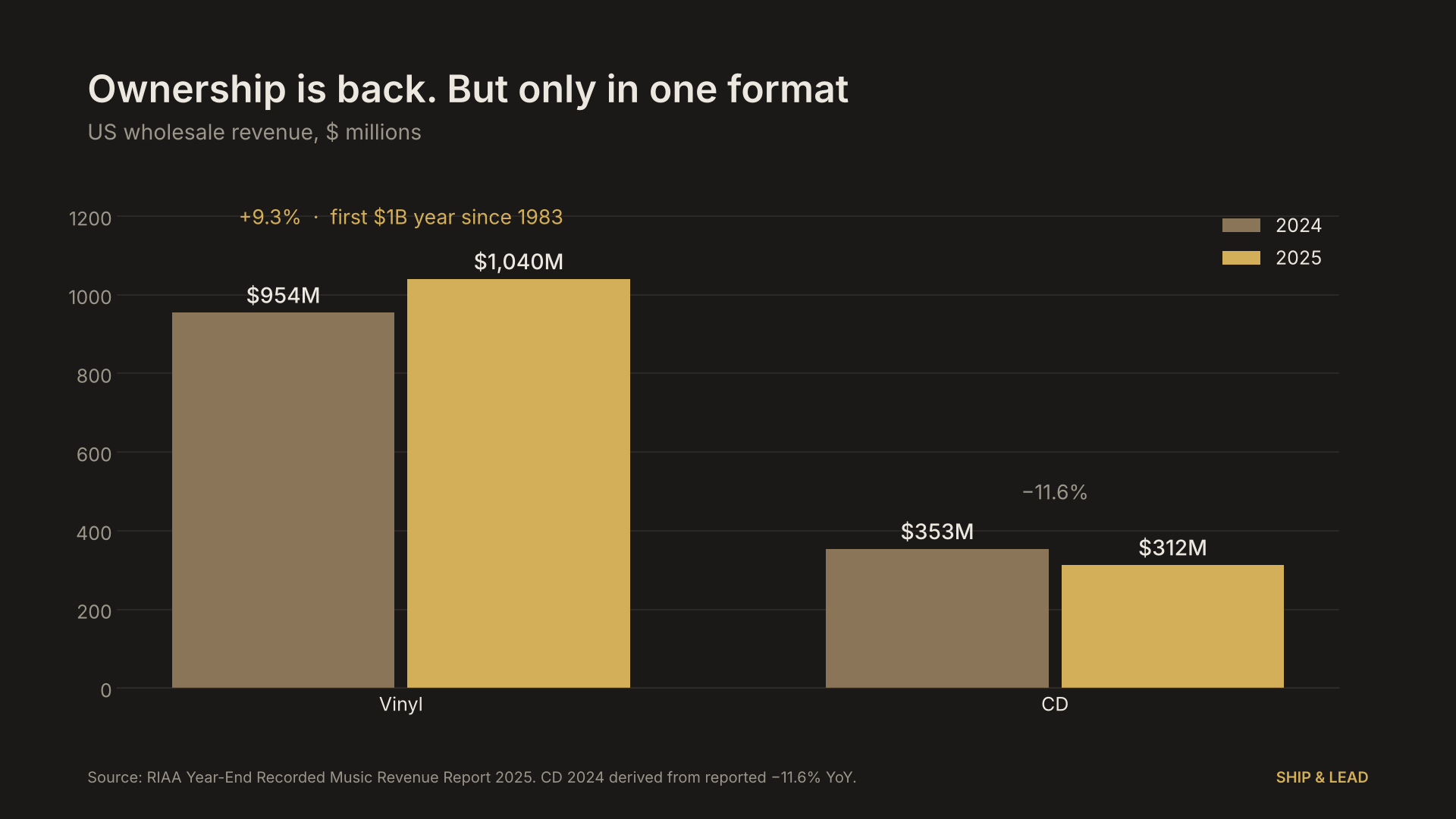
Vinyl passed $1 billion in US revenue in 2025 for the first time since 1983, its 19th straight year of growth. Streaming still dominates; this is an addition, not a replacement. But the people driving the physical revival are not the ones you would expect.
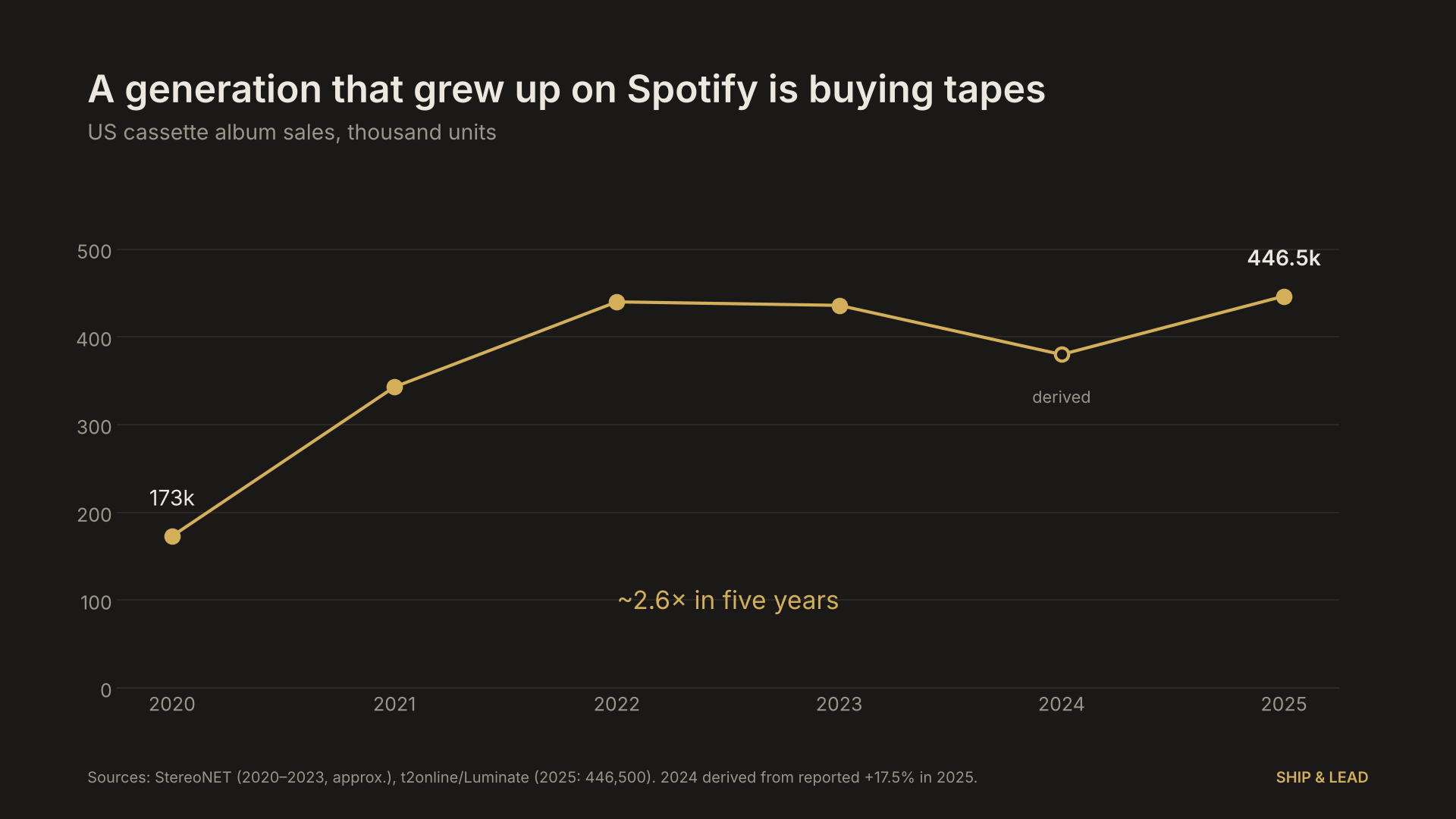
Gen Z, the generation that grew up on Spotify, is buying cassettes and Walkmans. They have no nostalgia for these formats; they never owned them. Gen Z didn’t buy a Walkman for nostalgia. They bought a boundary against digital dependence. A device that does one thing sends no notifications and makes no recommendations. Buyers explain it plainly: artists disappeared from streaming, and physical media feels real in a world of rentals.
Three levels of the same question
The same instinct runs from the individual to the state. Each level asks one question: who can take away what I paid for?
- Consumers. Amazon once deleted 1984 from customers’ Kindles – and again: isn’t it ironic? Ubisoft switched off The Crew, a game people had bought, which triggered the Stop Killing Games campaign: 1.29 million verified EU signatures. In June 2026 the European Commission declined to propose new legislation. Demand for ownership is measurable; regulators are not delivering it.
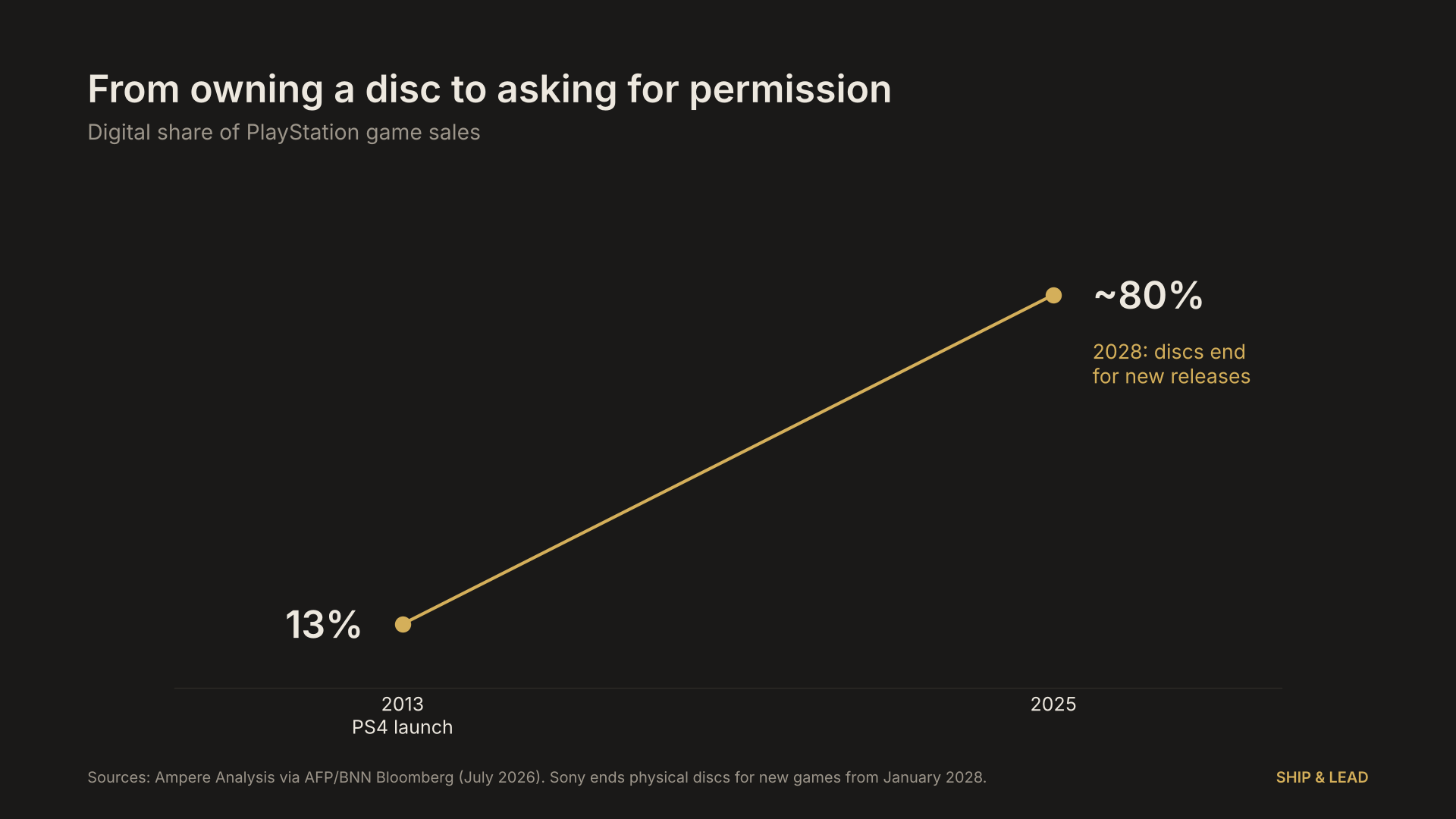
- Platforms. Sony will stop releasing new PlayStation games on disc from January 2028. Digital already makes up roughly 80% of game sales, up from 13% in 2013. The console has a purchase price, but every game on it becomes a revocable permission.
- States. After US sanctions in 2025, the chief prosecutor of the International Criminal Court lost access to his Microsoft email and moved to a Swiss provider (Microsoft says it did not cut off the court itself). Denmark’s digital ministry is replacing Office 365 with LibreOffice. Schleswig-Holstein has cancelled nearly 80% of its Microsoft licences, saving about €15 million a year. Even AWS now sells a separately operated European Sovereign Cloud. Sovereignty has moved from a feeling to a purchase criterion.
Carmakers went further. BMW charged a monthly fee for heated seats already built into the car, then dropped it in 2023 after a backlash. Audi kept going: buyers of the A3 had to subscribe to unlock features like adaptive cruise control, and navigation in the US cost $85 a month. Some included services expire with the first owner, so the second buyer pays again for the same hardware. Ask the sales rep who pays for features in his company car that are already built in. His frustration is easy to find. For a CEO, that is not a simple consumer story. It is a fleet bill, an admin burden and a team of annoyed employees.
It looks like an MBA case study on digital business models, executed without a single customer in the room. I say that as someone with an MBA in digital transformation. The degree gives you the tools. Only the reality of your customers turns them into value. Recurring prices need recurring value. It is one reason youngtimers, cars with no subscriptions and nothing to switch off, are so popular right now – next to roaring V6, V8 and V12 engines.
Physical was never the point
It is tempting to read all this as physical versus digital. It is not. Retro games and other abandonware from the 1990s still install today, because they ask nobody for permission. Old consoles can be modified because control lives in hardware you own. A modern console or a SaaS product checks online whether you are allowed. Control sits with the vendor.
Ownership has two layers. The first is the platform: who controls where it runs. The second, more important one is the format: who can read it. For example, my own music library lives on a network attached storage (NAS) in my home, served by an open-source app. If that app is abandoned tomorrow, I can still play every file with a Winamp from 2002 or a hardware MP3 player. The MP3 patents expired in 2017; the format belongs to no one, so everyone can read it. A downloaded Spotify track sits on my phone too, but it is encrypted and dies with the subscription. Physically present, still not mine.
Music actually solved this once. Apple sold iTunes songs with DRM until 2009, then dropped it. A song bought then still plays now. Games and enterprise software went the other way, towards more platform control. That proves it was a business decision, not a technical necessity.
I don’t own the app. I own my music. That is the difference. For software executives the uncomfortable conclusion follows directly: real lock-in does not live in your application. It lives in your data format – and the genius of your product. Enterprise buyers once protected themselves with source-code escrow, the right to run critical software if the vendor disappeared. SaaS quietly removed that safeguard. Customers are now rebuilding it themselves. In October 2026, a single developer released vibe-coded clones of seven Adobe apps, from Photoshop to InDesign, built with Claude. By his own account they are an early alpha, and testers call them glitchy, but they work. Imagine what this means for your software when a suite with 30 years of development behind it can be imitated by one person first, and improved later. Standard software becomes a foundation for tailor-made solutions.
Leave the door open
Don’t lock in with force but with function, convenience and innovation. This has been my credo as a product leader for the last two decades. If you have to force your users to stay, you have already lost. They will long to leave, even when they have everything they need. Build the best product and give them the freedom to go whenever they want; experience says they will stay.
Years ago in Germany, I was a customer of Alice DSL (even most Germans won’t know or remember them – this was the time when AOL was still promoting its service with free trial hours before it got flushed away completely by DSL flat rates) until it shut down. I chose it for one reason: it was the only provider I could cancel monthly. Everyone else locked customers into two-year contracts that renewed automatically for another year. In a dynamic environment that meant more speed and/or lower costs every other month, this didn’t make sense to me.
Since March 2022, German law requires exactly what Alice offered. After the minimum term, consumer contracts may only continue with monthly cancellation. The industry fought it. I’m positive it was a blessing for them. My mobile contract has run with the same carrier for years past its term, precisely because I could leave any month. And every few months they give me a reason to stay: more data, a better tariff, an upgrade offer. Finally, customer loyalty pays off.
That is the incentive flip. Locked-in customers do not need to be courted, so the best deals went to new customers. Regulators even have a name for it: the loyalty penalty. The UK banned it for home and motor insurance in 2022. Hiding the exit is getting expensive too: in March 2026, Adobe agreed to a $150 million settlement with the US Department of Justice over early termination fees that, according to the government, customers only saw when they tried to cancel. Adobe denied any wrongdoing. Once customers can leave monthly, budget moves from acquisition to retention by performance.
For SaaS the translation is direct:
| Lock-in logic | Open-door logic |
|---|---|
| Discounts in year one, price rises at renewal | Existing customers get new value first |
| Annual auto-renewal with long notice periods | Monthly or flexible terms |
| Proprietary data schema | Open formats, full export |
| Customer success when churn threatens | Customer success before anyone is unhappy |
One caveat keeps this honest. Freedom alone keeps no one. Alice DSL had the better contract and still disappeared. Openness is the precondition, not the product. If you leave the door open, you force yourself to get better every month.
Two things stay scarce
The music industry has already lived through what AI is about to do to software. When the copy became worthless, two things kept their value: the performance and the boundary. The concert that cannot be streamed, and the record on the shelf that no one can switch off.
For software leaders, that turns into four questions worth putting on the next leadership agenda:
- What is our live performance? Which part of the value we deliver cannot be generated, copied or commoditised: implementation, integration, outcomes, trust?
- What is our album? Which pricing unit only exists because of how software used to be delivered, and what happens to it when agents do the work?
- Who holds the key? Can our customers keep using what they paid for if we stop, are acquired, or are no longer allowed to serve them? Are their data in formats they can take with them?
- Why do our customers stay? Because they want to, or because they cannot leave? Only one of those answers survives the next decade.
You can hold customers through your format or because you are the best interface to their data. The first works until customers notice. The market data says they are noticing now. That said, save the irony for great pop songs and set the pace for your business’ future.
Take it to your next leadership meeting. Download the one-page executive summary: the four questions, build first versus bridge first, and the metrics that make the decision for you.
Sources
- RIAA 2025 Year-End Recorded Music Revenue Report, via Billboard
- RIAA report coverage, Music Week
- Rockonomics highlights (Alan Krueger)
- PRS: live music overtakes recorded music in the UK, Clash
- Cassette sales, t2online
- Cassette sales 2020–2023, StereoNET
- Gen Z and cassettes, Channel News
- SaaS pricing models 2026, Userpilot (Cruxy CEO survey)
- Per-seat to usage and outcome pricing, SoftwareSeni (Gartner)
- Seat-based licensing data, ai2.work (CRV, Pilot)
- Forward deployed engineer demand, Paraform
- Forward deployed engineers, Fast Company
- Stop Killing Games: Commission examination, European Commission
- Commission response to Stop Destroying Videogames, European Audiovisual Observatory
- Sony ends game discs from 2028, BNN Bloomberg
- ICC prosecutor loses Microsoft email, AP via PBS
- Microsoft’s response on the ICC case, heise
- Danish ministry moves to LibreOffice, OMG! Ubuntu
- Schleswig-Holstein Linux migration, BornCity
- AWS European Sovereign Cloud launch, Business Wire
- BMW drops heated seats subscription (Slashdot, via Forbes)
- Audi A3 buyers have to subscribe to use basic car features, Jalopnik
- Audi’s $85-a-month navigation subscription, Jalopnik
- Someone vibe coded a free knockoff of Adobe Creative Suite, Gizmodo
- Adobe to pay $150 million settlement in subscription cancellation lawsuit, PetaPixel