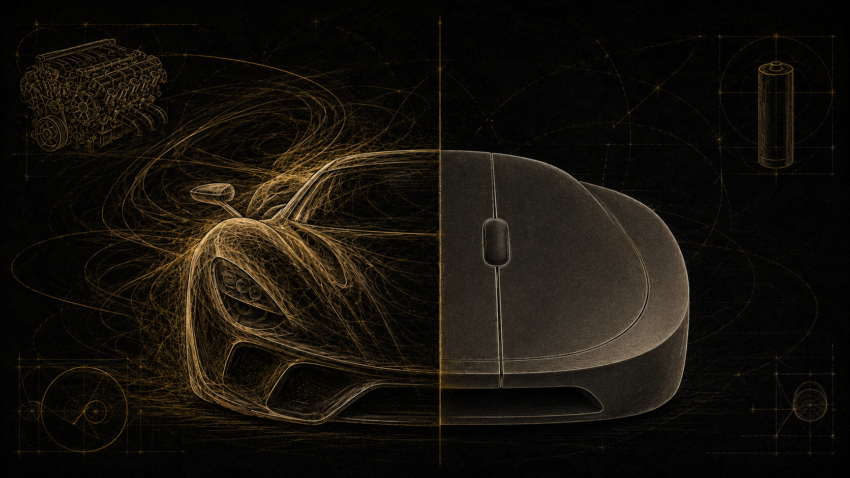
“I don’t sell cars; I sell engines. The cars I throw in for free, since something has to hold the engines in.” // Enzo Ferrari, Founder of Ferrari
The luxury car industry has, since 2024, put together a winning streak of failed digital transformation that you couldn’t have scripted better. Jaguar deleted its brand, relaunched, and lost 97 percent of its sales. Mercedes-AMG sells its electric future through benchmark numbers, as if a sports car were a hard drive. Audi unveiled a new design language and bolted it onto a V8 hybrid, without asking the actual question at all. And then comes Ferrari – with five years of preparation, a budget in the tens of millions, and Apple design superstar Sir Jony Ive personally in the building.
The result is the high point so far of this escalation. Not because the Luce is the worst car of the four. But because it proves that even the best designer in the history of consumer electronics cannot solve the problem if the company that hired him never understood the actual question. When Jony Ive fails at this task, it isn’t Jony Ive who fails. What fails is the idea that you can buy digital transformation instead of thinking it through.
The Escalation Ladder: How an Entire Industry Got the Same Problem Wrong, Differently
Three cases before we get to Ferrari – because they show this isn’t an isolated incident, but an industry pattern with ever-new variants of the same underlying error: the quiet misunderstanding that a car is ultimately the same as a Louis Vuitton bag – a status symbol whose value comes primarily from logo and surface design, not from what it actually does.
Jaguar pulled off the most radical version of this thinking error in 2024. The brand deleted its entire social media history, unveiled a 32-second ad film with androgynous models in pink, abstract landscapes – without showing a single car – and declared slogans like “Delete Ordinary” and “Copy Nothing.” The result wasn’t a culture shock that fades. It was a collapse: European registrations fell from 1,961 vehicles in April 2024 to 49 in April 2025. That’s proof you can treat a brand like a fashion house – but only as long as the underlying product plays along. When it doesn’t, the market notices within weeks.
Mercedes-AMG makes the same mistake in a more serious, less spectacular form. The GT XX concept is sold almost entirely through numbers: 1,341 hp, top speed over 360 km/h, 40,075 kilometers covered in under eight days on Nardò’s high-speed track, a drag coefficient of 0.198. Impressive engineering – but the same logic used to sell a hard drive: more storage, more throughput, more benchmark scores. One tester who saw the concept in person described his first impression this way: a family car that grew out of a real sports car, not a sports car adapted for family practicality. Specs are the automotive industry’s equivalent of Louis Vuitton’s logo embossing – visible, impressive, but not what actually constitutes the category “sports car.”
Audi shows the more cowardly variant of the same failure. The Nuvolari arrives with a new “Radical Simplicity” design language – but under the hood sits a conventional twin-turbo V8 hybrid built on borrowed Lamborghini Temerario architecture, developed in 440 days, limited to 499 units, with no statement whatsoever about whether this design language can carry over into an electric future. This isn’t even an attempt to ask the question of what the heart of a sports car looks like once the combustion engine disappears. They draped new sheet metal over the old, proven answer and call it progress – not even the consistent courage to fail that the other three cases on this list mustered.
Credit where it’s due to Audi: at least they didn’t put out a design that shamelessly panders to Gen Z buyers and looks as if a European designer working for a Chinese manufacturer threw together the supposed best of Europe in a wild mashup, that kind of citation-salad aesthetic you increasingly see from some Chinese premium brands – and lately also from AMG or Ferrari. With its Lego Technic-style design, Audi is clearly still catering to Gen X buyers. While some members of my generation might still buy a Lego Technic toy kit for nostalgic reasons, as a kind of weekend mindset therapy, I don’T know anybody who would be putting a 1:1-scale building-block design car in their garage for serious money, let alone want to drive it. Staying conservative, in other words, is not automatically the safer bet. It’s just a different way of avoiding the actual question – this time not through a lack of courage toward the new technology, but through a lack of courage toward one’s own aging target audience.
Three different failures, one shared root: every brand believed it could renew the brand promise through a new surface – logo, spec sheet, retro citation – without rethinking the product’s actual function. With a handbag, that works, because the function (carrying things) is trivial and stable, and the value really does come primarily from branding. With a sports car, the function is a complex, historically grown sensory promise. Anyone who approaches that with handbag logic will fail, reliably.
Why the Luce Is the Sharpest Case of Digital Transformation Failure Anyway
Here one could object: Ferrari actually did it right, unlike the other three. No courage deficit like Audi, no pure numbers fetish like AMG, no brand hara-kiri like Jaguar. Ferrari hired arguably the best designer of the last thirty years and gave him five years.
That’s exactly what makes this case so revealing. With Jaguar, AMG, and Audi, you can still blame the failure on poor execution – wrong agency, too little courage, too much fixation on numbers. With Ferrari, that excuse disappears. Here, the execution was first-rate. Sir Jony Ive and Marc Newson are not bandwagon followers of a trend – they’re the people who shaped the design language of the entire consumer electronics industry for a generation. If the result fails anyway, it’s not because the wrong people were at work. It’s because the brief itself was wrong, before anyone even picked up a pen.
The Two Problems You Can’t Confuse
The Luce has two design layers, and they were solved with the same method – which is the actual mistake.
The interior is an interface problem. The driver interacts with buttons, displays, haptic controls. That’s exactly the discipline LoveFrom has been world-class at for decades: reduction, clear hierarchy, precise haptics. Here, transferring Apple principles worked, because the underlying problem is structurally similar.
The exterior shell is a coachbuilding problem. A sports car’s form isn’t held in the hand – it’s perceived from a distance and in motion. It has to communicate tension while standing still, through light edges, surface musculature, the illusion of stored energy. That’s a different discipline with different rules, refined over a century by carrozzerie like Pininfarina, Bertone, Zagato.
Ferrari solved both problems with the same tool: product-design logic from the consumer electronics world. On the exterior, the result is a car that looks like an oversized gadget – a Magic Mouse on four wheels, not a sports car.
That was avoidable. Not by doing without Ive – but by not leaving him alone. At Apple itself, this corrective existed: Ive was in permanent conflict with hardware engineering teams who told him what wasn’t physically possible – thermals, antenna physics, board layout. Antennagate on the iPhone 4 is the most famous example of that friction. That very resistance sharpened Apple’s products. At Ferrari, the equivalent was missing: no one in the room with the same authority to say, “this surface generates no downforce, this line doesn’t communicate speed.” A tension field between coachbuilding knowledge and interface design could have forced a genuinely new design language. Instead, a single team got unlimited freedom – and solved a problem nobody had (UI), while the problem everybody has (form) went unanswered.
False Revolution: A Step Backward, Not Forward
Here it gets conceptually interesting. A revolution is, by definition, a step toward something qualitatively new – not toward something older or more generic. You don’t behead the king only to install a patchwork of petty princedoms afterward.
What’s being sold as a “new design language” on the Luce isn’t a new design language at all. It’s a form that already exists in the market – on family vans, on Chinese mid-range EVs. And that very comparability is the real business risk: Xiaomi’s SU7 deliberately echoes Porsche Taycan cues – front light signature, side line, aggressive diffuser language – for a fraction of the price. The user interface in these cars now makes more than a few Tesla owners turn green with envy. Xiaomi has, in effect, already shown what you’d actually expect from European luxury manufacturers – sporting ambition paired with digital substance. Just at mid-range prices. If aggressive sports car styling is now reproducible by practically any manufacturer with good CAD tools and aero simulation, then that design language is no longer a moat.
Ferrari responded by taking a step in the opposite direction: away from the uncopyable, decades-refined design language – toward a generic premium-EV aesthetic that anyone can produce. It’s tempting to suspect that ideas from the never-released Apple Car found their way in here. But that points to something deeper: the current Ferrari management apparently understands neither the past nor the future of its own brand. Apple is not a congruent model for Ferrari. Steve Jobs originally modeled Apple on Sony – and where Sony was minimalist but Japanese-reliable, Apple absorbed a playfulness and a Bauhaus heritage into its products, heavily inspired by Dieter Rams and Braun. German and Japanese cars are considered solid and reliable. Ferrari’s myth was never solid and reliable. Ferrari is the moody Italian diva you love for her looks and for her tension – that’s Sophia Loren, that’s Monica Bellucci. Apple’s Zen-inspired design works perfectly well as feng shui for the cabin. But on the outside, it has to stay exciting. What’s happened here isn’t democratization in any positive sense. It’s surrendering your own differentiation at the exact moment competitors are catching up most aggressively.
The Real Failure: The Heart of the Product Was Never Digitized
This is the core of the argument, and it’s a direct critique of a chronic misunderstanding of digital transformation in established companies.
Most corporations run digital transformation as a transformation of the periphery: processes, sales channels, user interfaces. The uncomfortable, actually decisive question – how do I transform the core product itself? – gets systematically avoided, because it’s harder and demands more courage. And even in cases where an industry leader becomes its own innovation driver, it often doesn’t dare cannibalize its legacy cash cow with the innovative product. Kodak invented the digital camera and let it sit in a drawer, because the film business was too profitable to attack on its own. This fear of self-cannibalization is one of the most reliable patterns by which established market leaders fail.
At Ferrari, that question reads: how do I digitize the V12? Not the button that controls it. The engine itself – or more precisely, the experience it produces. The exact experience that turned Enzo Ferrari from a race driver into the Commendatore. The experience that made Ferruccio Lamborghini want to do it better than Ferrari. The experience that turned characters like Magnum or Sonny Crockett into icons of the eighties. And the experience that, alongside Enzo himself, makes drivers like Niki Lauda, Michael Schumacher, and most recently Lewis Hamilton larger than life.
How seriously this experience is taken as the brand’s core is shown by the reaction of Luca Cordero di Montezemolo, Ferrari’s former president from 1991 to 2014 and, for many, the man who led Ferrari out of financial crisis to becoming a global luxury powerhouse. His reaction to the Luce was unusually blunt: if he said what he really thought, he’d be doing Ferrari harm – there’s a risk of destroying a myth, and he’s deeply sorry about it, he said, suggesting they at least remove the prancing horse from the car. These aren’t the tears of a boomer who can’t cope with a modern reality – this is the sharpest public criticism of a current Ferrari product by a former CEO that industry observers can recall. Even Flavio Briatore couldn’t resist a sarcastic jab of his own: at least, he noted, this is one Ferrari the Chinese definitely won’t be copying.
Even the official PR response from Ferrari’s own brand ambassadors looks two-edged on closer inspection. Lewis Hamilton described the Luce in the promo video as “very Ferrari” – a phrase social media promptly reinterpreted: “very Ferrari indeed, just like Hamilton’s own previous season right now”. His hesitant first reaction when asked how his circle outside the racing world had received the car was also read by many observers less as enthusiasm than as diplomatically packaged frustration. If even the most favorably disposed available voice – an active Ferrari works driver fulfilling contractual brand duties – gets ironically picked apart by the brand’s own fan base, that’s a telling sign of how deep the divide between brand leadership and the public really runs on this product.
The Ferrari sound is not decoration. It’s emergent information – it communicates rpm, load state, mechanical drama, without the driver needing to glance at a tachometer. That’s high-bandwidth, physically processed feedback, built up over seventy years of fusion between machine and human perception. That function disappears entirely with electric propulsion. And nobody – not Ferrari, not Porsche, not Lamborghini – has found a real answer to that yet.
The attempts so far are symptom management, not problem-solving:
- Artificial speaker-generated sound that responds dynamically to the accelerator – in the most extreme case even offered as downloadable content, choose your V6, V10, or V12 sound. That’s not product innovation. It’s a con played on the customer, dressed up as a feature. A classic pattern of bad product management: the customer names a solution (“I want the V12 sound”), and you build exactly that instead of understanding the underlying need. The moment the driver realizes it’s simulated, trust in the signal collapses.
- Pure g-force drama (Tesla’s answer) – works for the initial “wow” effect, but delivers no story over time. A V12 narrates revving, load changes, gear shifts as a process. An electric motor delivers a single, almost instantaneous statement.
Neither approach asks the right question. And the right question isn’t “how do I produce a good sound” – it’s: what is the psychological function that sportiness fulfills, detached from the historically grown but ultimately contingent technical carriers of that function?
What Sim Racing Reveals About the Real Answer
There’s a near-perfect natural experiment that already answers this question: sim racing. An e-sports racer playing Gran Turismo on a PS5with a gamepad or wheel setup has no genuine physical engine sound, no real g-forces, no real danger – and still experiences flow, arousal, hours of engagement.
What’s left once you strip away almost all the classic stimuli? Visual speed perception. Immediate, latency-free control feedback. Force feedback in wheel and pedals that shifts with tire grip. And – probably the most underrated factor – the cognitive load of line choice, braking points, real-time risk-reward calculation.
That matches established flow research: flow emerges from the fit between challenge and skill, not from sensory density alone. Sound is probably an amplifier, not a cause.
The implication is radical: if you translate this complete, multi-channel sensory system – visual, haptic, auditory, cognitive – coherently into a real vehicle, the exterior form becomes almost irrelevant to sales success. A Luce that delivered a genuinely spectacular new driving and sensory experience would sell, even wearing this shell. The real problem isn’t that the Luce looks like a family sedan. The real problem is that it offers no category in which it beats its ev competition – except maybe in some cases battery range, which is irrelevant to this target audience.
The Tech Discipline the Auto Industry Is Missing
Tech-industry product management follows a brutally simple rule: a successor product must be clearly better than its predecessor in at least one dimension the target audience actually cares about. Faster, more capable, better looking, cheaper – something has to justify the leap.
The Luce doesn’t meet that bar. Not more emotionally engaging. Not more spectacular to drive. Acceleration figures are already inflated and meaningless as a differentiator across EVs. The only clearly “new” thing is interface quality – and that’s exactly the least relevant selling point for a customer who isn’t spending €500,000 for a nice touch experience.
The Real Lesson for Every Established Company
Steve Jobs’ real contribution to the iPod wasn’t the design. It was the strategic translation: “We have a portable hard drive. If the hard drive becomes the medium, all we need is an interface around it.” Ive cast that vision into form – brilliantly, but secondarily. The transformation idea came from a different function than the design function.
Ferrari bought the translator without anyone internally playing the Jobs role: asking the uncomfortable question of what the Walkman-to-iPod moment actually is for a sports car, before giving it form. That question was never asked. Instead, trust got confused with understanding – a design team brilliant at reduction and interface, but with no experience answering what makes a sports car a sports car at its core, was given unlimited freedom, instead of being placed in a productive tension field with people who’ve spent decades wrestling with exactly that question.
This isn’t a Ferrari-specific point. It’s the point for every company that confuses digital transformation with digitizing the surface – new apps, new interfaces, new touchpoints – while the actual question stays unanswered: what is our product’s core function, detached from the technology that historically carried it? And how do we rebuild that function for the new technological reality – not imitated, not simulated, but newly justified?
Whoever answers that question first for the sports car – Ferrari, Lamborghini, an outside challenger – will have a moat nobody can copy, because it isn’t made of form, but of a newly understood experience.
And that’s the real point of the Luce, the thing that sets it apart from Jaguar, AMG, and Audi: with those three, you can still hope the right people will do better next time. At Ferrari, the right people were already there – and they couldn’t change anything, because nobody asked them the right question. That’s no comfort. It’s the most uncomfortable version of the lesson: you can hire the best translator in the world, and it won’t help if nobody decided beforehand what actually needs translating.