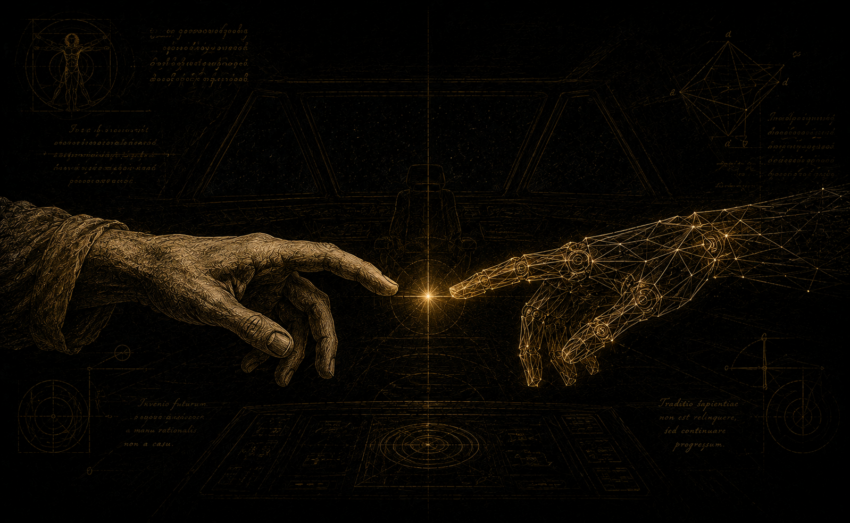
Working with Claude, Gemini or ChatGPT is starting to feel like working with the AI we know from science fiction – and it’s reshaping what AI product leadership actually looks like in practice. Not the menacing kind – Terminator, the Matrix. Though we’d be naive to pretend that future isn’t on the table if AI development stays as unhinged as it currently is. The other kind. The Star Trek kind. The one that sits quietly in the background, processes more context than any single person could hold in their head, and waits for you to ask the right question. No ego. No agenda. No bad days. That’s a strange thing to notice after two decades of working with human engineers, not androids. The shift turns out to run deeper than it first appears. AI still isn’t foolproof – far from it. But something is already saying goodbye: the hands-on engineer who solved the unsolvable through sheer will. In Star Trek, that character has a name. Montgomery Scott.
The Miracle Worker
If you didn’t grow up watching Star Trek, here’s what you missed: Montgomery Scott – “Scotty” – is the Chief Engineer of the USS Enterprise in the original series from the 1960s. He is, in the most literal sense, the man who keeps the ship running. Brilliant, proud, Scottish, and utterly indispensable.
Sounds familiar? It’s no coincidence. Ask any software engineer which Star Trek character from the Original Series they relate to most – chances are it’s Scotty. The brilliant specialist who delivers miracles under pressure, and gets precious little credit for it.
His signature move? Telling Captain Kirk that something is impossible – and then delivering it anyway, usually in half the time, under fire, with the ship already falling apart.
There’s a reason fans called him “the miracle worker.” And there’s a reason Kirk kept pushing him.
Kirk knew exactly what he was doing. He didn’t just need Scotty’s technical skill. He needed Scotty’s pride. Push the right button, express just enough doubt, and suddenly the impossible becomes a matter of professional honor. The warp core gets fixed. The ship survives. Mission accomplished.
It wasn’t manipulation. It was leadership – the deeply human kind that understands what makes people tick and uses that understanding to get extraordinary results.
The Art of the Impossible
I’ll be honest: decades ago, I learned to code. Pascal, Java – enough to understand what’s happening under the hood. But I would never call myself a developer. That would be an insult to the people who actually are. Real engineering requires a patience and passion I don’t have – the ability to trace dependencies across thousands of lines of source code without losing the thread.
What I do have is something different: the ability to understand complex problems at their core and translate them across audiences. Between business and tech. Between what a stakeholder wants and what an engineer can build. Between vision and implementation.
And over the years, working across early-stage startups, scale-ups, and PE-backed environments, I learned something that no product framework ever taught me: the most powerful tool in a product leader’s arsenal isn’t a roadmap or a prioritization matrix. It’s knowing what makes your engineer tick.
The pattern repeated itself more times than I can count. Bring a complex feature to a senior engineer. Hear “not feasible.” Don’t push back directly – instead, ask questions. Show genuine curiosity about the problem. Let them think out loud. And then wait.
A few hours later, the same engineer who told me it couldn’t be done would come back with: “You can start testing.”
They hadn’t changed their mind because I argued. They changed their mind because they fell in love with the problem. The moment they started turning it over in their head, it stopped being my request and became their challenge. Their professional pride did the rest.
That’s the Scotty dynamic in real life. Kirk didn’t win by outranking Scotty. He won by understanding him.
A New Kind of Crew Member
Twenty years after Kirk and Scotty first took the Enterprise to warp, Star Trek returned with a new ship, a new captain, and a fundamentally different vision of the future.
Star Trek: The Next Generation – TNG to fans – premiered in 1987. The USS Enterprise-D is bigger, faster, and more sophisticated than anything Kirk ever commanded. And its captain, Jean-Luc Picard, couldn’t be more different from Kirk. Where Kirk led with instinct and charisma, Picard leads with intellect and deliberation. Less cowboy, more diplomat. Less gut, more Aristotle.
But the most radical addition to the crew wasn’t Picard. It was Data.
Lieutenant Commander Data is an android – an artificial being of extraordinary computational power and zero emotional capacity. He processes information faster than any human, recalls everything perfectly, and has no ego, no bad days, and no personal agenda. He is, in the most literal sense, a non-human intelligence serving alongside a human crew.
What makes Data compelling – and what made TNG one of the most watched sci-fi series in history – is not what Data can do. It’s how Picard works with him. There’s a memorable episode where Picard doesn’t order Data to solve a problem. He asks him to think through it out loud. He listens. He pushes back. He takes Data’s output and applies his own judgment before acting.
Picard understood something instinctively that most leaders today are still figuring out: a non-human intelligence doesn’t need managing. It needs the right questions.
The Engineer Evolves
Scotty had a successor. His name is Geordi La Forge.
Chief Engineer of the Enterprise-D, Geordi is Scotty’s direct counterpart in the TNG era – same role, same responsibility, same fundamental mission: keep the ship running against all odds. But where Scotty operated on instinct, experience, and sheer force of will, Geordi is analytical, methodical, and diagnostic. Less “I’ll hold her together with my bare hands” and more “let me run the numbers first.”
There is actually a remarkable episode where both characters share the screen – Scotty is recovered from a transporter buffer after being suspended there for 75 years and finds himself on the Enterprise-D. He and Geordi clash immediately. Scotty can’t understand why Geordi doesn’t just push the systems past their limits. Geordi can’t understand why Scotty would. Two generations of engineering philosophy, face to face.
Which brings us to where we are today.
| Captain | Engineer | AI | |
|---|---|---|---|
| TOS (1960s) | Kirk | Scotty | – |
| TNG (1987) | Picard | Geordi | Data |
| Today | Product Leader | Dev Team | LLM / Agents |
Scotty evolved into Geordi. Kirk evolved into Picard. And Data? Data is something entirely new – a role that didn’t exist before. Not an engineer. Not a captain. An intelligence that sits alongside both, processes context at scale, and returns options, analysis, and drafts – but always needs a Picard to decide what to do with them.
The dev team didn’t disappear. Your Geordi is still there, still essential, still the one who keeps the ship running. But there’s a new crew member on the bridge. And most product leaders have no idea how to work with them yet.
The Skills That Transfer
Here’s the good news: if you spent years learning how to get the best out of engineers, you’re already more prepared than you think.
The instincts transfer. What changes is where you apply them.
With Scotty – with your human engineers – the game was about motivation, pride, and timing. Knowing when to push, when to trust, and when to plant a seed of doubt and walk away. It was people leadership in its most nuanced form.
With Data – with AI – none of that applies. There is no ego to manage. No Monday morning mood to navigate. No professional pride to activate.
What applies instead is this:
Context. AI is only as good as the situation you put it in. The product leader who can frame a problem precisely, provide the right background, and define what a good answer looks like – that person gets dramatically better output than someone who types a vague question and hopes for the best. This is not a technical skill. It’s a communication skill. One you’ve been building for years.
Judgment. Data never makes the final call. Picard does. The ability to evaluate an AI’s output – to know when it’s right, when it’s plausible but wrong, and when it’s confidently missing the point – requires exactly the kind of domain knowledge and pattern recognition that comes from years in the field. Junior people struggle with this. Experienced leaders don’t.
The right question. Kirk told Scotty what he needed. Picard asked Data how to think about it. The shift from instruction to inquiry is subtle but significant. The best AI interactions aren’t commands – they’re conversations. And knowing how to have a productive conversation with a non-human intelligence turns out to look a lot like knowing how to have a productive conversation with a brilliant but literal-minded engineer.
You’ve been training for this longer than you know.
The Final Frontier
AI product management means, on the long run, saying goodbye to Mr. Scott and embracing Data. Not because engineers are disappearing – your Geordi is still there, still essential, still the one who keeps the ship running. But because there is a new kind of crew member on the bridge, and the leaders who thrive in the next decade will be the ones who learn to work with them effectively.
The encouraging truth is this: the skills that made you good at leading Scotty are the foundation for leading Data. Context, judgment, the right question at the right moment. You don’t need a prompt engineering course. You need to recognize what you already have.
Picard didn’t become a better captain by understanding Data’s neural net architecture. He became a better captain by knowing what to ask – and what to do with the answer.
That’s still the job. The crew just looks different now.
Which brings me back to where this started. Working with Claude feels like exactly that – less like issuing commands, more like thinking something through with a sharp, tireless, slightly literal-minded crew member. So I asked for its side of the story of working with me as a human. “Aye brings exactly what makes human-AI collaboration work: context, judgment, and the ability to know when to push. Working with him feels less like answering queries and more like thinking through problems together.”
— Claude, Anthropic (Take that with a grain of salt. The feedback is of course ultimately a reflection of my own work. Which is, of course, exactly the point.)